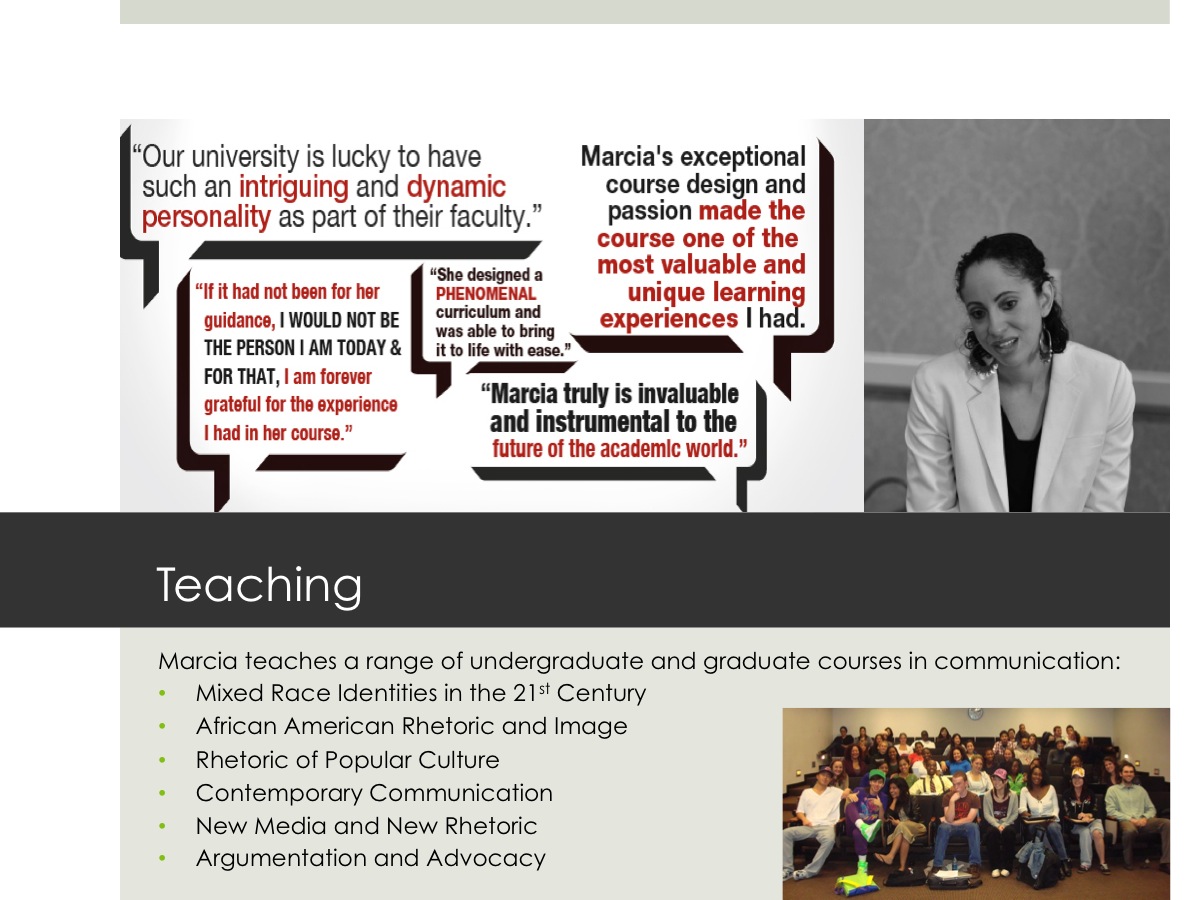
Teaching
Sex, Love, Race, Talk: Mixed Race Relationships, Identities & Interracial Communication
This course is designed explore the conditions and consequences for crossing racial boundaries in North America. We take a multidisciplinary approach, exploring literary, anthropological, historical and communication approaches along with several feature and documentary film treatments of the subject.
- Add new comment
- Read more
- 12651 reads
Argumentation & Advocacy
The primary objective of this course is to understand the theories and practices of argumentation, apply them to generate meaningful public discussion of current events, and innovate by creating and critiquing new forms of public argumentation.
- 10 comments
- Read more
- 8054 reads
African American Rhetoric & Image
|
This course is designed to help us understand how African Americans have used symbols to construct and reconstruct images of themselves and their communities over time, primarily through music, public address, and media.
|
- 6 comments
- Read more
- 6883 reads
Rhetoric and the Public Sphere
This lively and engaging course provides an introduction to rhetoric and the public sphere, exploring how communication is used to shape the minds and actions of individuals and the broader public.
- Add new comment
- Read more
- 4151 reads
New Rhetoric and New Media
This course is designed to develop our understanding of the relationship between language, persuasion, and technological changes. We will focus on the ability to analyze language use and discourse, and changes in discourse in digital communication contexts.
- Add new comment
- Read more
- 5247 reads
Communication Theory
The primary objective of this course is to offer an alternative focus on the most important theories of communication in today’s globalized and mediated society. Communication Theory presents an historic range of communication theories, including interpretive, (new) media, critical, rhetorical, cultural, and scientific.
- 4 comments
- Read more
- 5649 reads
Racial Rhetoric & Representations
The primary objective of this course is to explore the ways that race is constructed in U.S. media and political rhetoric. Students will gain a fuller understanding of the ways race is constructed, projected and reified through media. We interrogate how racial stereotypes and hierarchies are maintained and challenged rhteorically in various media texts.
- Add new comment
- Read more
- 4903 reads
Introduction to Human Communication
The primary objective of this course is to introduce students to the field of human communication as an area of study and skill development. The course is a “hybrid” of instruction in both interpersonal and public communication.
- 5 comments
- Read more
- 7535 reads
Communication Skills for Career Development
This course is designed to provide students with a practical application of the contemporary communication skills necessary for career development and career success. Topics include investigation of career fields and the communication and technology skills that are essential to those careers.
Contemporary Communications
This course introduces students to the fundamentals of effective communication in contemporary society. The primary focus is on communication using electronic means, such as cell phones, e-mail, instant messaging, and Internet technologies. Topics include communication methods and technologies and their impact on the individual and society.
- 7 comments
- Read more
- 10668 reads